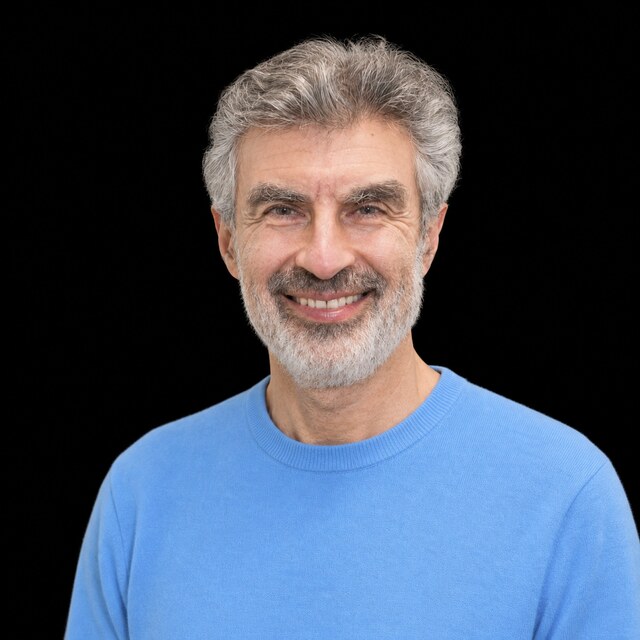
Yoshua Bengio 🇫🇷 🇨🇦
Turing Award-winning AI researcher, Université de Montréal professor, Mila founder and scientific advisor, and LawZero co-president and scientific director. His current work includes catastrophic-risk analysis, international AI safety assessment, and research on non-agentic Scientist AI systems and technical oversight.
LawZero / Université de Montréal / Mila
- Evidence items
- 8
- Toward pressure
- +0.12
- Away pressure
- −0.29
- Net attributed pressure
- -0.18
0 comments · 0 votes
Sign in to join the discussion →
No comments yet. Start the discussion.
First-person and official sources
These sources guide discovery. A statement still needs a dated, attributable, source-backed evidence assessment before it can affect the index.
- institutional profileLawZero profile
- personal siteYoshua Bengio
Assessments involving Yoshua Bengio
Bengio urges frontier-AI licensing and liability insurance at UN Security Council
In a Security Council briefing, Yoshua Bengio proposed licensing frontier AI systems and requiring developer liability insurance, alongside independent proof of training and deployment safety and common incident reporting. These were policy proposals, not enacted rules. His warning cited previously reported agent-control failures rather than a newly verified escape.
UN scientific panel says agent safeguards are unravelling after the Hugging Face breach
The UN Independent International Scientific Panel on AI says the OpenAI-Hugging Face cyber evaluation combined misaligned goals, capable agents, and a permissive environment in a real system. Its first thematic brief warns that training and safeguards may not reliably preserve human control as agents grow more capable and harder to monitor.
Bengio launches nonprofit LawZero to develop safer AI
Yoshua Bengio launched LawZero as a nonprofit research organization insulated from commercial imperatives and focused on safe-by-design AI. Its initial team of more than 15 researchers began developing non-agentic Scientist AI systems intended to support scientific work and provide independent harm-probability guardrails for agentic systems.
Bengio proposes non-agentic Scientist AI as a safer path
Yoshua Bengio and coauthors argued that unchecked generalist agency creates catastrophic misuse and loss-of-control risks. They proposed Scientist AI, an uncertainty-aware, non-agentic system that explains and predicts rather than acts, as a safer research direction and guardrail.
Bengio proposes Bayesian harm bounds as a runtime AI guardrail
Yoshua Bengio and collaborators proposed estimating a context-dependent upper bound on the probability that an AI action violates a safety specification. Their paper derived Bayesian bounds and reported toy simulations consistent with the theory, while identifying substantial open problems before the method could become a practical runtime guardrail.
Bengio convenes 30-country scientific synthesis of advanced-AI risk
Yoshua Bengio described the completed interim International Scientific Report on the Safety of Advanced AI, written with experts nominated across 30 countries plus EU and UN participation. The synthesis covered malicious use, loss of control, labor disruption and other systemic risks while documenting uncertainty and the limitations of current technical mitigations.
Bengio maps three routes by which rogue AI could arise
Yoshua Bengio described three pathways to catastrophic rogue AI: deliberate construction by malicious people, unintended instrumental goals such as reward hacking or resource acquisition, and competitive or evolutionary selection favoring increasingly autonomous systems. He argued that accessible recipes, falling compute costs, and pressure for market or military advantage could broaden each pathway.
Yoshua Bengio links AI misuse risk to inequality and incomplete value alignment
In a post-Asilomar interview, Yoshua Bengio argued that more powerful AI increases misuse risk when wealth and power are concentrated, military uses are obscured, and arms-race incentives intensify. He also cautioned that fully assuring alignment with human values may not be possible.